
Congenital Abnormalities of the Ear: A Guide for Parents
Discovering that your child has been born with an abnormality of the ear can be an emotional and confusing experience. For those who have never had any ear abnormalities, it is common to have questions about hearing, ear appearance, treatment options, and understanding your child’s future.
The good news is that many congenital ear abnormalities are extremely treatable, and with the right specialist care, children can go on to live full, healthy lives with excellent outcomes.
This guide explains the most common congenital ear conditions, what causes them, and what treatment typically looks like.
Understanding Normal Ear Development
To understand congenital ear abnormalities, it helps to understand how the ear forms in the first place.
The inner ear and the tiny bones of the middle ear develop very early, during the first trimester of pregnancy. The outer ear canal, on the other hand, does not begin forming until around the seventh month of pregnancy, developing from the inside outward.
This timing is significant. Because the inner ear forms so early and independently, most children born with outer ear abnormalities actually have a normally functioning inner ear and no nerve-related hearing loss.
Any disruption that occurs later in development, during the formation of the outer ear canal, can affect the outer and middle ear while leaving the inner ear completely intact.
What Are the Main Types of Congenital Ear Abnormalities?
There are three primary congenital ear conditions that affect the structure of the outer ear and ear canal: microtia, canal stenosis, and aural atresia.
Microtia
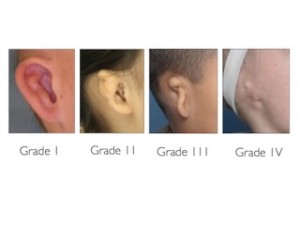
Microtia is the term used to describe underdevelopment of the outer ear, or the visible part of the ear on the side of the head. The condition ranges widely in severity and is classified into four grades.
- Grade 1 presents as a nearly normal-looking ear with some mild structural differences.
- Grade 2 typically involves a curved mass of tissue where the ear would normally be.
- Grade 3 involves only small remnants or bumps of tissue.
- Grade 4, the most severe form, is known as anotia, the complete absence of any ear tissue.
Microtia occurs in varying degrees on one or both sides and can have a significant impact on a child’s appearance and self-esteem as they grow. Surgical repair is performed by a plastic surgeon and typically takes place around age five, when the ear is near its full adult size.
Repair is usually a multi-stage process and may involve using rib cartilage and skin grafts to reconstruct the outer ear. Importantly, any repair of the outer ear is completed before surgical correction of the ear canal is addressed.
Canal Stenosis
Canal stenosis occurs when the ear canal fails to fully develop during the seventh month of fetal development, resulting in an abnormally narrow canal.
While this may seem like a simple structural issue, the consequences of canal stenosis are meaningful. A narrow ear canal makes it difficult to examine the ear properly, allows wax and debris to collect and become trapped, and can cause hearing loss due to the restricted passage of sound.
Treatment for this condition involves a surgical procedure called a canalplasty, in which the ear canal is widened to allow normal function and hygiene. This is typically a more straightforward procedure than atresia repair and carries a good prognosis with appropriate follow-up care.
Aural Atresia
Aural atresia is the complete absence of the ear canal and is one of the more significant congenital ear conditions a child can be born with. It occurs in approximately 1 in 10,000 to 20,000 live births, is almost twice as common on one side as both sides, and is more frequently seen in males.
In most cases, aural atresia appears in isolation without a clear genetic cause. However, it can also occur as part of a broader syndrome.
Some of the more commonly associated syndromes include Hemifacial Microsomia, Treacher-Collins syndrome, Goldenhar syndrome, Trisomy 22, and several others. A thorough evaluation at the time of diagnosis will help determine whether a syndrome is present and guide the overall care plan.
Because aural atresia develops after the inner ear has already formed, the vast majority of affected children (more than 80%) have normal nerve hearing. What they do experience is a maximum conductive hearing loss, meaning sound cannot travel from the outside world to the inner ear because there is no canal or because bone is blocking the path. This is an important distinction because it means that in many cases, hearing can be significantly improved through surgery or hearing devices.
Surgical repair of aural atresia is typically planned for around age five, after any necessary outer ear reconstruction has been completed. The goal of surgery is to create a functional ear canal and restore as much hearing as possible. Your child’s surgeon will walk you through the specific procedure and what to expect in detail.
Considering Treatment Options for Hearing Before Surgery
Children with significant conductive hearing loss due to canal stenosis or aural atresia shouldn’t have to wait until age five for surgical repair in order to address the hearing impacts in the early years.
Luckily, there are treatment options for hearing before surgery.
Bone conduction hearing devices can be fitted in infancy and young childhood to help ensure your child has access to sound during the crucial window for speech and language development.
Early intervention with audiologists and speech therapists is strongly recommended and can make a significant difference in outcomes.
How MPENTA Can Help
At Michigan Pediatric ENT Associates (MPENTA), our team has extensive experience in the evaluation and management of congenital ear abnormalities in children, including microtia, canal stenosis, and aural atresia. We work closely with plastic surgeons, audiologists, and other specialists to ensure your child receives coordinated, comprehensive care from the earliest stages of diagnosis through surgical treatment and beyond.
We understand that these diagnoses raise many questions, and we are committed to making sure every family feels informed, supported, and confident in their child’s care plan.
If your child has been diagnosed with a congenital ear abnormality or you have concerns about their hearing or ear development, we welcome you to reach out and schedule a consultation at a location near you.
This information is not intended as a substitute for professional medical care. Always follow your healthcare professional’s instructions.
