
Understanding External and Outer Ear Deformities in Newborns
The appearance and shape of a newborn’s ears can vary significantly during early development.
Some babies are born with differences in the shape or position of the outer ear, known as external or outer ear deformities. These conditions are relatively common and may affect one or both ears.
At MPENTA, our pediatric ENT specialists evaluate and treat newborn ear deformities using non-surgical ear molding techniques and, when appropriate, surgical correction later in childhood.
Early evaluation is important because many ear deformities respond best to treatment during the first weeks of life.
What Is an External or Outer Ear Deformity?
An external ear deformity refers to a difference in the shape, folding, or position of the outer ear cartilage. These deformities develop during pregnancy as the ear forms in utero and may be influenced by positioning, pressure, or incomplete cartilage development before birth.
Approximately 15% to 30% of newborns are born with some type of ear deformity. While some mild deformities may improve slightly over time, many do not fully correct on their own and may benefit from early treatment to improve ear shape and symmetry.
Unlike conditions involving hearing loss or inner ear abnormalities, most outer ear deformities primarily affect the appearance and contour of the ear.
Common Types of Ear Deformities in Newborns
There are several types of external ear deformities commonly treated in pediatric ENT practices.
Lop Ear / Cup Ear / Constricted Ear
Lop ear occurs when the upper portion of the ear folds downward or appears constricted. The top rim of the ear may look compressed, folded over, or tightened inward.

An example of Lop Ear / Cup Ear / Constricted Ear
Stahl’s Ear
Stahl’s ear is sometimes called a “pointed ear” deformity. An extra fold of cartilage creates an abnormal shape at the top of the ear, giving the ear a more pointed appearance.
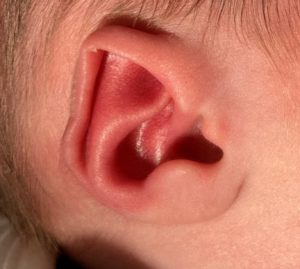
An example of Stahl’s Ear
Protruding or Prominent Ears
Prominent ears occur when the outer ears extend farther away from the head than expected, typically greater than 2 centimeters. This may affect one or both ears.
Combination Ear Deformities
Some newborns may have a combination of multiple deformities affecting different portions of the ear cartilage and outer ear structure.
Why Early Evaluation Matters
The first few weeks of life are the ideal time to evaluate newborn ear deformities because the cartilage of the ear is still soft and moldable. Elevated maternal estrogen levels present after birth make the ear cartilage especially pliable during this period.
This window of flexibility typically lasts until approximately 6 weeks of age. After that time, the cartilage gradually stiffens, making non-surgical correction less effective.
Because of this, early referral to a pediatric ENT specialist is suggested if parents notice:
- Folded or misshapen ears
- Pointed ear appearance
- Ear asymmetry
- Ears protruding outward
- Abnormal ear folds or cartilage shape
Non-Surgical Ear Molding Options
At MPENTA, we offer several ear molding options designed to gently reshape the ear without surgery.
Ear Splinting
Ear splinting uses flexible molding materials placed carefully on the newborn ear to gradually guide the cartilage into a more typical shape. The splints are secured with steri-strips and adjusted during regular follow-up visits.

Flexible splint made in office
Treatment is most effective when started during the first or second week of life and typically continues for approximately 2 to 6 weeks depending on the severity and type of deformity.
Benefits of ear splinting include:
- Non-surgical treatment
- Painless correction
- More than 90% effectiveness when started early
- In-office treatment process
- Reduced likelihood of needing surgery later in childhood
Results of ear splinting:
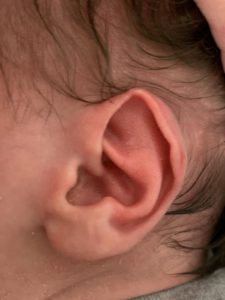
Before
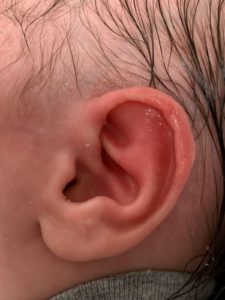
After
EarWell® Infant Ear Correction System
MPENTA also offers the EarWell® Infant Ear Correction System, an FDA-approved ear molding device designed specifically for newborn ear deformities.
The EarWell device fits over the ear and uses soft retractors to gently reshape the cartilage over time. Treatment usually begins within the first two weeks of life and may require multiple applications depending on the deformity.

EarWell® Parent Page – EarWell® Infant Ear Correction System (earwells.com)
Accessed 06/15/2021
Benefits of the EarWell system include:
- Non-surgical treatment
- Over 90% success rate when started early
- Painless correction process
- Lower cost compared to future surgery
- Potential insurance coverage in some cases
Because the effectiveness of ear molding decreases significantly after 6 weeks of age, prompt evaluation is important when a deformity is identified.
Surgical Treatment: Otoplasty
If an ear deformity is not corrected during infancy or cannot be fully improved through ear molding, surgical correction may be considered later in childhood.
Otoplasty is a surgical procedure used to reshape or reposition the ears and is typically performed after approximately 5 years of age, once ear growth is more developed.
Surgical treatment may be recommended for:
- Persistent prominent ears
- Significant asymmetry
- Constricted ear deformities
- Residual deformities after ear molding
Because otoplasty is often considered cosmetic, insurance coverage may vary.
When Should Parents Seek Evaluation?
Parents should contact a pediatric ENT specialist if they notice:
- Folded or misshapen ears in a newborn
- Pointed ear appearance
- Ear asymmetry
- Ears protruding significantly from the head
- Concerns about ear shape during the first weeks of life
Early treatment offers the best opportunity for successful non-surgical correction and may help avoid future surgical intervention.
Pediatric Ear Deformity Care at MPENTA
At MPENTA, our pediatric ENT specialists provide comprehensive evaluation and treatment for newborn ear deformities and external ear abnormalities.
We work closely with families to determine the best treatment approach and provide early intervention options designed to support long-term cosmetic and developmental outcomes.
